Carrito
0
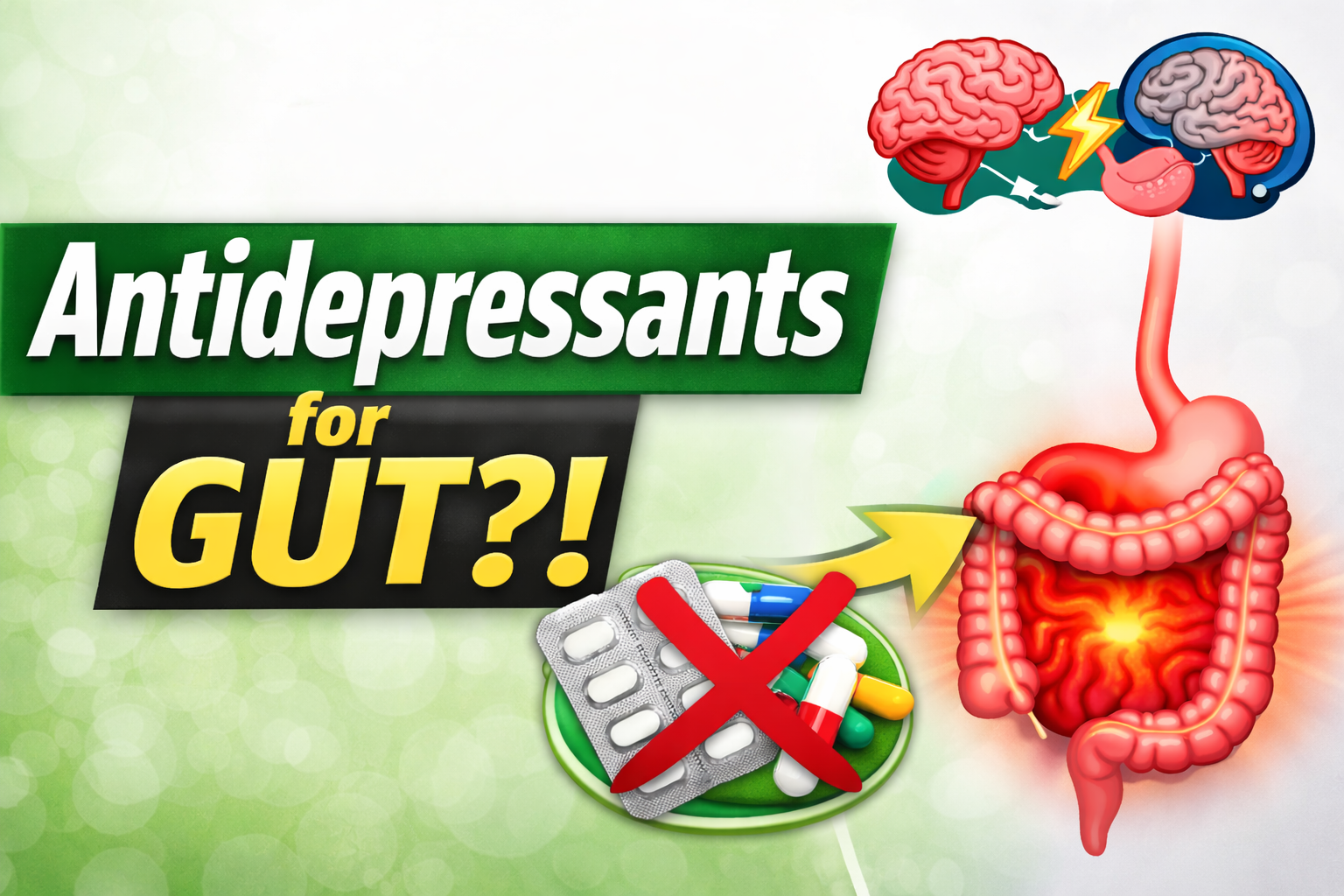
Have you heard about the use of antidepressants with GI issues? Find out on this next episode of Digest This.
👉 Click here to listen
👉 Click here to watch on YouTube
Hello and welcome to Digest This I'm Dr. Liz Cruz and I've got Tina Nunziato sitting right here by my side. Thank you for joining us. If you are a first-time listener, we welcome you. And if you're one of our regular listeners, we love you. Thank you for being on this journey with us. Let's jump right into this topic. I will admit this is not a favorite topic of mine.
Don’t get me wrong, I think it's a great topic. It's not my favorite topic because I was never a fan of prescribing antidepressants in my patients who had GI issues. But it is done. It actually is in our guidelines, especially in functional GI. What does that mean? Basically we're not really finding a cause for GI issues, but maybe somebody continues to have this pain up here in their upper abdomen, or maybe they're continuing to have issues with their heartburn or pain in their chest, and all their workup has been negative. Which is very common.
They've had an endoscopy, biopsies everything has come back negative. They've had a CAT scan, a full workup, even in somebody with chest pain or difficulty swallowing. And they've had a cardiac workup, which is all negative. They had a chest CT, everything, everything is negative, but they're still coming in, having issues. And so, you know, it's an area that is tough because traditional medicine says we can't find anything.
Let's keep going and let's think of something else we could do. In traditional medicine, you know, that's the way we were taught. You know, you're looking for treatments, but you always want to look for evidence-based treatments as you're practicing traditional GI.
When these patients are still coming back, and it typically... I shouldn't use the word typically, but a lot of times...a lot of these patients also have issues with anxiety, maybe depression. They have other issues which probably play into some of these symptoms. I and I've had plenty of patients through the years who have told me, doc, I still get this pain here, or I still have this discomfort up here, and I've seen my cardiologist and they say, it's not your heart. And I'll ask him, “Do you feel that these episodes happen when you're under a lot of stress and anxious?” And a lot of times they will admit that. They will definitely admit that.
There are a lot of people out there that are in that situation. They're constantly stressed, constantly anxious. Their health issues make them more anxious. So, then they bring more stuff on because of that. So, if it is anxiety, depression, then it's okay, why don't we put them on an anxiety or depression medicine?
Let's talk about some of these anxiety, depression meds. Okay, these are antidepressants, like tricyclic antidepressants, you've got the selective serotonin reuptake inhibitors or otherwise known as the SSRIs. I would say that those are the main classes throughout the years. Now, in my training, I can't even remember specifically a mentor or an attending who used these regularly. It wasn't probably as popular back then. It was used, but because even when I came out of training and I was already practicing, there would be patients that would come into the practice who had been started on that by somebody else. And so, it just wasn't the common thing that was used. I didn't really get that experience in using it in my training. I could have gotten the experience once I got out and was in my own practice, but I just was never hip on them and probably because they were antidepressant medicines.
Now, when you use them in GI, when you use these medicines, you actually are using them at much lower doses than what they're used for when they're being used as an antidepressant or anti-anxiety medicine. You are using them at a much lower dose, which by that token, means the side effects from them wouldn't be as strong, but you can still get some pretty powerful side effects. For example, with the tricyclic antidepressants, some of the common side effects are constipation because they will slow down the GI tract.
Some people will get drowsiness, blurry vision, some people will feel nauseated. Those are some of the side effects from those medicines. So you're taking a medicine to try to affect your GI issues, but then you end up having GI issues. Exactly, exactly. You know, let's just back it up a little bit, okay? So when you're dealing with functional disorders, functional GI disorders, one of the thoughts is that people that have these functional GI disorders, for example, irritable bowel syndrome, very common, tend to have more sensitive gut than when they're exposed to what would be considered normal stimulation.
This means the same stimulation, that someone who doesn't have these functions like IBS may be felt much more by someone who does have IBS. They may be more hypersensitive. So the mechanism of action with these medicines, tricyclics and the SSRIs, they do what they call neuromodulation. So they're basically modulating or they're kind of coming in, we're at the point of chemicals, okay? Because the tricyclics inhibit the uptake of serotonin and norepinephrine, whereas the SSRIs are dealing more with the serotonin. These are chemicals in your body. And there's a lot of interplay.
You've heard of the brain-gut axis, that basically is that connection between the brain, the central nervous system, and the nervous system of the gut, which is called the enteric nervous system. And so there is definitely a lot that goes on with all those chemicals as far as the mood of the gut, as far as affecting people's sensitivity to stimulation. So like I said, somebody who has IBS is probably more hypersensitive to, okay, let's use gas. Let's use gas. Everybody has gas. Okay, we all have gas. And even if you don't think you have gas, you have gas. Maybe you don't feel it. Maybe you feel you don't fart or burp as much, you know, but everybody has gas. A person who has a functional GI issue such as irritable bowel or functional dyspepsia, which is discomfort in the stomach, or even stuff with the esophagus, that person, okay, would be much more sensitive to a bubble of gas in their esophagus or gas in their stomach or even in their colon compared to someone who doesn't have it. In other words, you could have two people that have the same amount of gas and the person with hypersensitivity is going to feel it more. They're going to have pain and discomfort and cramping in their gut if they have irritable bowel.
So where these medicines come in is they modulate these chemicals to try to decrease the sensitivity to the gas that is still there, you're just not feeling it. And like I said, the doses of these medicines, they're much lower than what is typically used for when depression or anxiety is being treated.
I never felt comfortable using these meds. Number one, I just wasn't trained with them. And I never felt that I needed them. But the other thing is I always felt that if there was an issue with depression or anxiety or something like that, that that person needed to be under the care of someone that specialized in that so that they could get treated for that.
Maybe go see a counselor, if the counselor or the psychologist or whoever they're seeing feels that they need some pharmacologic prescription, then that could be addressed by them.
Maybe try behavior therapy or try counseling or try something that does not involve a drug. Okay. Because there's a lot of evidence-based behavior therapies, okay. That are out there that can help people where they don't end up having to be on a drug. And, if you know us, I mean, we've been on this wellness journey for almost 20 years now.
Our goal has been to get people off their medicines. So though I could have learned how to use these medicines and started them at low doses and become comfortable with them, I didn't want to, okay? Because I wanted to treat that person in a more holistic fashion. And I felt through the years, especially as we delved deeper and got deeper in our journey of learning about nutrition and wellness and treating stress in a more holistic fashion. I felt that what we were doing with that, we were helping more of our patients than putting them on another medicine. So I've never been a fan of these medicines.
I think it's great that they're there. I know that there are gastroenterologists that do use them and that's fine. I'm not here to make any criticism or judgment. Okay, we all have our level of comfort and what we do I think what happened with us and with me as a gastroenterologist is that we got on another pathway of a more holistic approach and as I got deeper in my career I was starting to feel guilty about prescribing medicines in general because I knew that there was a better more holistic natural way to help my patients.
And then kind of to go along with that, the fact that most of these people that are on these medicines are people with GI issues and probably also are very highly anxious, prone to stress easily. That stress issue that people have causes a disturbance in the gut. You talk about the brain-gut correlation. Stress is going to cause lack of enzyme production. It's going to cause bacteria imbalance.
So instead of taking medicine, right, to regulate stress, you know, we would suggest taking enzymes and probiotics, right? And so, our commercial for today is getting on a good digestive enzyme and a good probiotic daily. If you are dealing with stress and high stress and you're an anxious person, you should absolutely be on enzymes and probiotics every day because these are the things that are going to help regulate the gut to get you digesting better and absorbing vitamins and minerals, and then also eliminating your food better.
Hopefully eliminating the digestive issues because you're supporting the gut, you're not taking medicine to cover up, again, putting a band-aid on what could be happening. Again, substituting stress and anxiety in a different way.
We also carry a product called Rescue Remedy, which is drops that go underneath the tongue. We've helped a lot of patients get off their anti-anxiety and depression medicine using Dr. Bach's Rescue Remedy, which is flower remedies that he's used to create a product specific fortoress and anxiety. So that's another option to help. But again, trying to minimize the number of medicines that we put in the body, because with every medicine that you're taking, it's going to have a side effect. So that's the scary part.
I do want to say if you are someone that is on medicine for anxiety, for depression, please do not stop your medicines. That is not what we are saying at all. If you are interested in more holistic approach though, you need to talk to your provider who has you on those medicines about that. Do not stop those medicines because you don't ever want to stop those medicines cold turkey like that. I do recognize that there are some people that are going to have to be on these medicines and thank God that we do have the availability of these types of medicines for those that do need to be on them. But if you're someone that is interested in a more holistic approach, talk to your provider and let them know and see what they can do to try to help you find a more holistic approach to what you're dealing with.
But anyways, that's on the note of depression and anxiety. Our focus for this today was more on the use of some of these medicines in treating people who have functional digestive issues. And we'd love to help you if you're one of those people that has IBS or you have chronic abdominal discomfort that you notice comes on maybe with stress and you've had a workup that's been negative.
Reach out to us and let us help you. You know, it could be as simple as maybe you need a food sensitivity test or just getting you on, as Tina said, the probiotics and the digestive enzymes. So, reach out to us. Our website is www.drlizcruz.com. You could schedule a free 30-minute wellness consult. It's done over the phone, so you could do it from anywhere. And that's our gift to you. And if you haven't connected with us, please connect, subscribe to our podcast and give us a rating and give us a five so that other people just like you will find us faster. Thank you so much for joining us and we'll catch you on the next podcast.